
The short answerHealth tech companies get recommended by ChatGPT, Claude and Google AI Overviews when AI tools can read clear pages that answer buyer questions, and find the same description of the product on review sites, lists and trade media. Check the answers every month, fix what AI gets wrong, and judge the work by the demos it brings in.
Ask an AI tool which scheduling software suits a small family practice, and it names 3 to 5 products. The practice manager who asked may never search Google at all. In a 2026 survey, 51% of B2B software buyers said they now start their research with an AI chatbot more often than with Google 1.
Most guides on answer engine optimization for healthcare are written for hospitals and practices that want patients to find them. This guide is for the other side of the sale: health tech companies whose buyers are practice managers, physician owners and IT leads, and who want their product named when those buyers ask AI what to use.
This guide is written by ARN, a healthcare marketing agency in Atlanta for health tech companies and medical practices. It covers how practice buyers ask AI about software, where the answers come from, 6 steps that help your product get recommended, how to check what AI says about you today, and how to measure the work. For the basics, start with our guide on what answer engine optimization is.
Key takeaways
- Practice buyers ask AI for software by role: the practice manager, the physician owner and the IT lead each ask different questions.
- AI answers about software lean on other sites: review profiles, "best" lists and trade media, alongside your own pages.
- 6 steps help: answer-first pages, fair comparison pages, real reviews, one product description, named experts and correct structured data.
- Check a fixed set of buyer prompts every month. One check proves little, because the answers change from run to run.
- Measure demos first, then Search Console, Bing Webmaster Tools and your prompt panel.
Your product gets recommended when the answer a buyer reads matches what your own pages and other trusted sites already say about it.
 Naman JhaPresident, ARN Management Consulting, LLC
What does it mean to get recommended by ChatGPT?
Getting recommended by ChatGPT means your product is named in the answer when a buyer asks an AI tool which software to use, ideally with a link to your page as a source. The same idea applies to Claude, Google AI Overviews and every major AI platform. The work behind it is usually called answer engine optimization, and ARN's answer engine optimization for healthcare service is built around it.
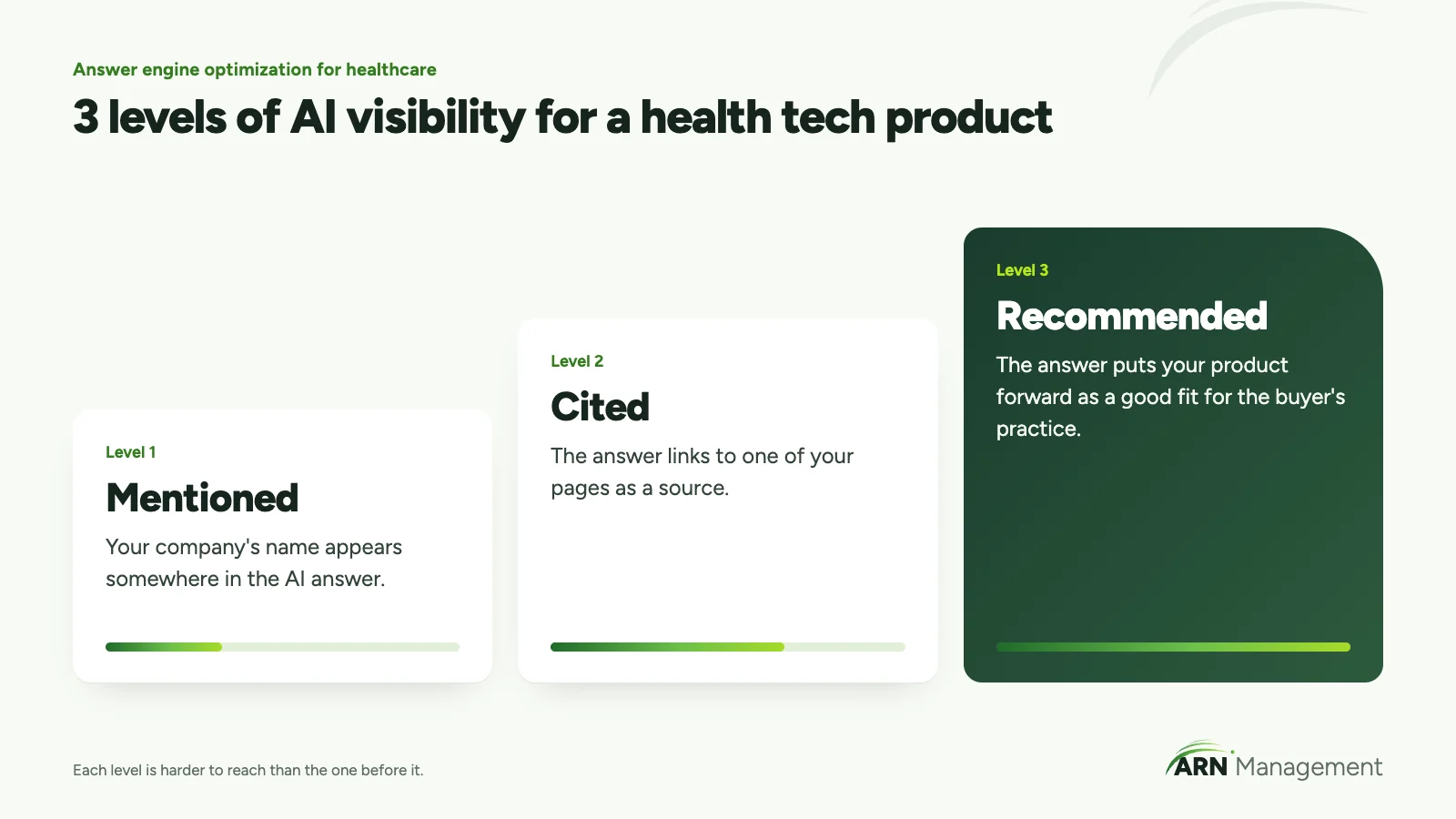
There are 3 levels, and each is harder to reach than the one before.
- Mentioned. The answer includes your company's name somewhere.
- Cited. The answer links to one of your pages as a source.
- Recommended. The answer puts your product forward as a good fit for the buyer's situation.
Google says there are no additional requirements to appear in AI Overviews or AI Mode, and that SEO best practices remain relevant 2. A health tech company with strong pages and a clear reputation starts with an advantage. The rest of this guide covers the next steps.
How do practice buyers ask AI about software?
Practice buyers ask AI about software in plain language, by role, and usually with their own practice in mind. More than 80% of physicians now use AI professionally 3, and the people around them ask the same tools about the software they buy.
The buyer is often more than 1 person. 42.2% of physicians worked in private practice in 2024, down from 60.1% in 2012, and 34.5% worked in hospital-owned practices 4. A product sold to a practice can be judged by an owner, a manager and an IT or security reviewer, and each one asks AI a different question.
| Who asks | What they ask AI | What the answer needs from you |
|---|---|---|
| Practice manager | "What is the best patient scheduling software for a small family practice?" | A page that names the practice size and specialty you serve, with prices or a clear way to get them |
| Physician owner | "Does this telehealth tool work with our EHR?" | An integrations page that lists each EHR by name and explains how the connection works |
| IT or security lead | "Is this software HIPAA compliant? Does the vendor sign a BAA?" | A security page with plain answers on HIPAA, the business associate agreement and data handling [LEGAL CHECK] |
| Operations lead at a larger group | "Which tools reduce no-shows across several locations?" | A use-case page with a result from a named customer and the number of locations involved |
Write down 5 of these questions for your own product, in the words your buyers use. They become the prompts you check every month.
Where do AI tools get their answers about software?
AI tools build answers about software from your own pages and from what other sites say about you. Several studies show how much weight the other sites carry.
- Lists. In an Ahrefs study of 750 prompts about software, products and agencies, "best X" blog lists were 43.8% of the page types ChatGPT cited 5.
- Earned media. An academic study found that AI search showed a systematic bias toward earned media, such as reviews and editorial coverage, over brand-owned content 6.
- Mentions. Across 75,000 brands, mentions on other websites correlated more strongly with AI Overview visibility than backlinks did 7. It is a correlation, and large brands skew it, but it points the same way.
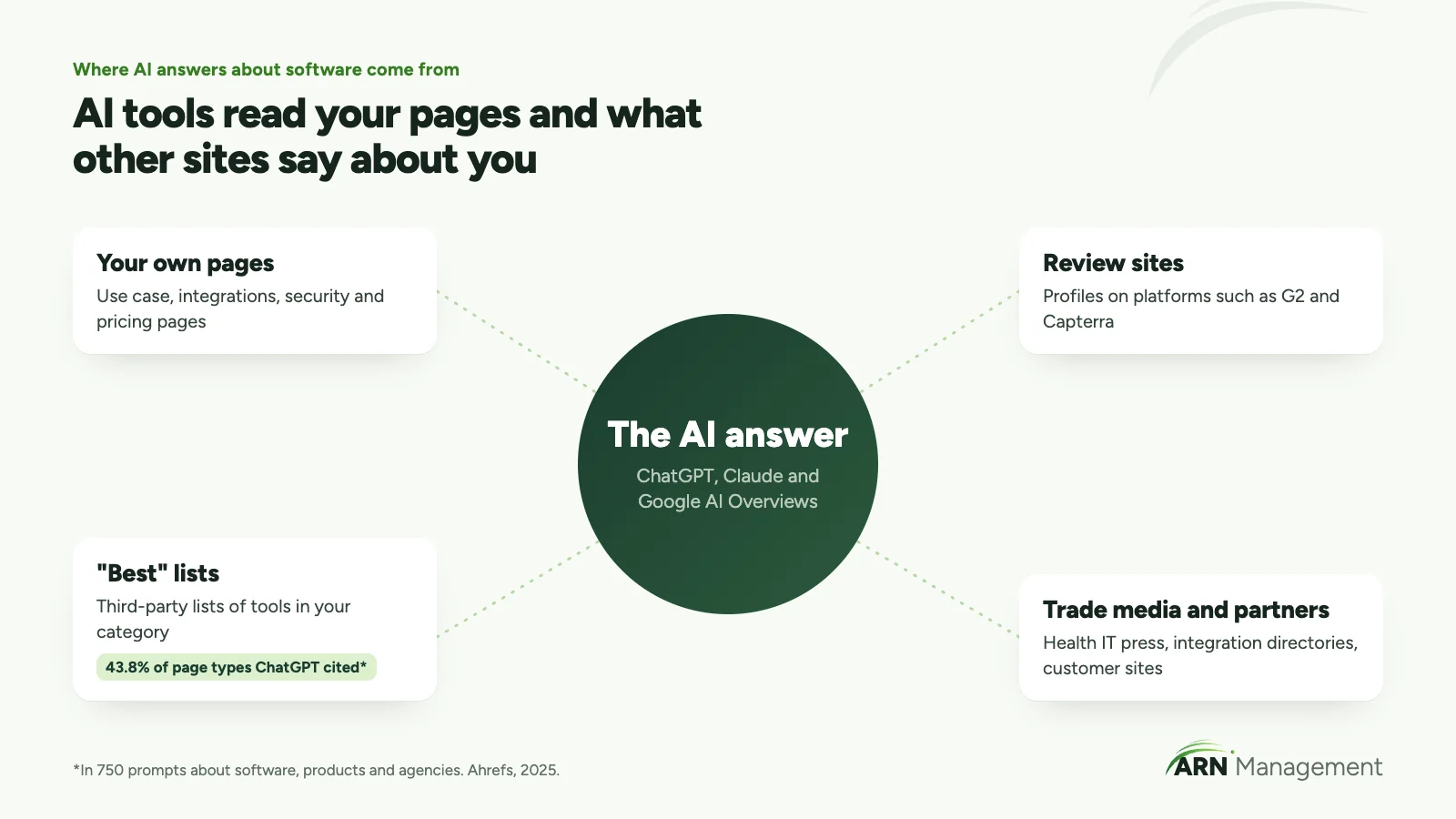
For a health tech product, the other sites are usually review platforms such as G2 and Capterra, health IT and trade media, partner and integration directories, and the websites of customers who name you. Your product gets recommended when the answer a buyer reads matches what your own pages and other trusted sites already say about it.
Can AI tools read your website?
AI tools can only recommend what they can read, so check that your website lets their search crawlers in. Each platform uses its own crawler for search answers.
- ChatGPT. OpenAI says sites that opt out of OAI-SearchBot will not be shown in ChatGPT search answers. GPTBot is a separate crawler used for training 8.
- Claude. Anthropic says blocking Claude-SearchBot may reduce your visibility in Claude's answers 9.
- Google AI Overviews. These use the normal Google Search index, with no extra requirements 2.
Ask whoever runs your website to check 3 things: that robots.txt allows these search crawlers, that the firewall or CDN does not block them, and that your main product facts appear in the page's text. Decisions about training crawlers such as GPTBot are separate, and you can make them on their own.
What 6 steps help a health tech product get recommended?
6 steps help a health tech product get recommended by AI tools. Each one makes your product easier to find, read and trust.
- Write answer-first pages for each buyer question. Give each of your 5 buyer questions a page that answers it in the first 2 sentences: a use-case page, an integrations page, a security page and a pricing page cover most of them.
- Publish fair comparison pages. Buyers ask AI to compare products. A page that compares your product with the usual alternatives, honestly and with dates, gives AI tools a source to quote. Google warns that pages made mainly to manipulate rankings or AI responses break its spam policies, so write each one for a real buyer 10.
- Earn reviews from real customers. Ask current customers to review you on the platforms your buyers use, such as G2 and Capterra. Never pay for reviews or write them yourself.
- Describe the product the same way everywhere. Use one short description, with the same category, buyer and main benefit, on your website, LinkedIn, review profiles, directories and partner pages.
- Show who wrote it, and keep it current. Google asks for bylines that lead to author information, and calls fabricated creator profiles a form of deception 11. Pages cited by AI assistants were about 25.7% fresher on average than pages in organic results 12, so update facts when they change and show the date.
- Keep structured data correct. Schema helps search engines understand your company and product. An Ahrefs experiment found that adding schema did not significantly increase AI citations 13, and Google says no special markup is needed for its AI features 10. Keep it accurate and spend most of the time on steps 1 to 5.
Here is how the pages map to buyer questions for a fictional telehealth product sold to behavioral health practices.
| Buyer question | Page that answers it | First sentence on that page |
|---|---|---|
| Which telehealth platform suits a small behavioral health practice? | Use case: behavioral health | "[Product] is a telehealth platform built for behavioral health practices with 1 to 20 clinicians." |
| Does it work with our EHR? | Integrations | "[Product] connects with [EHR names], so session notes and appointments stay in one record." |
| Is it HIPAA compliant? | Security | "[Product] signs a business associate agreement with every customer and encrypts sessions in transit and at rest." [LEGAL CHECK] |
| How much does it cost? | Pricing | "[Product] costs $[X] per clinician per month, with no setup fee." |
| How does it compare with [alternative]? | Comparison | "[Product] and [alternative] both offer video sessions; [Product] adds group therapy rooms and intake forms." |
How do you check if ChatGPT mentions your product today?
To check if ChatGPT mentions your product today, ask it your 5 buyer questions several times each and record what it says. Do the same in Claude and Google AI Overviews. A single check proves little: in a SparkToro study of 2,961 prompts, ChatGPT and Google's AI returned the same list of brands less than 1 time in 100 14.
Sources move too. Over 17 weeks, ChatGPT replaced as much as 74% of the domains it cited each week 15. So count how often you appear across many runs, and repeat the same panel every month. ARN runs it like this.
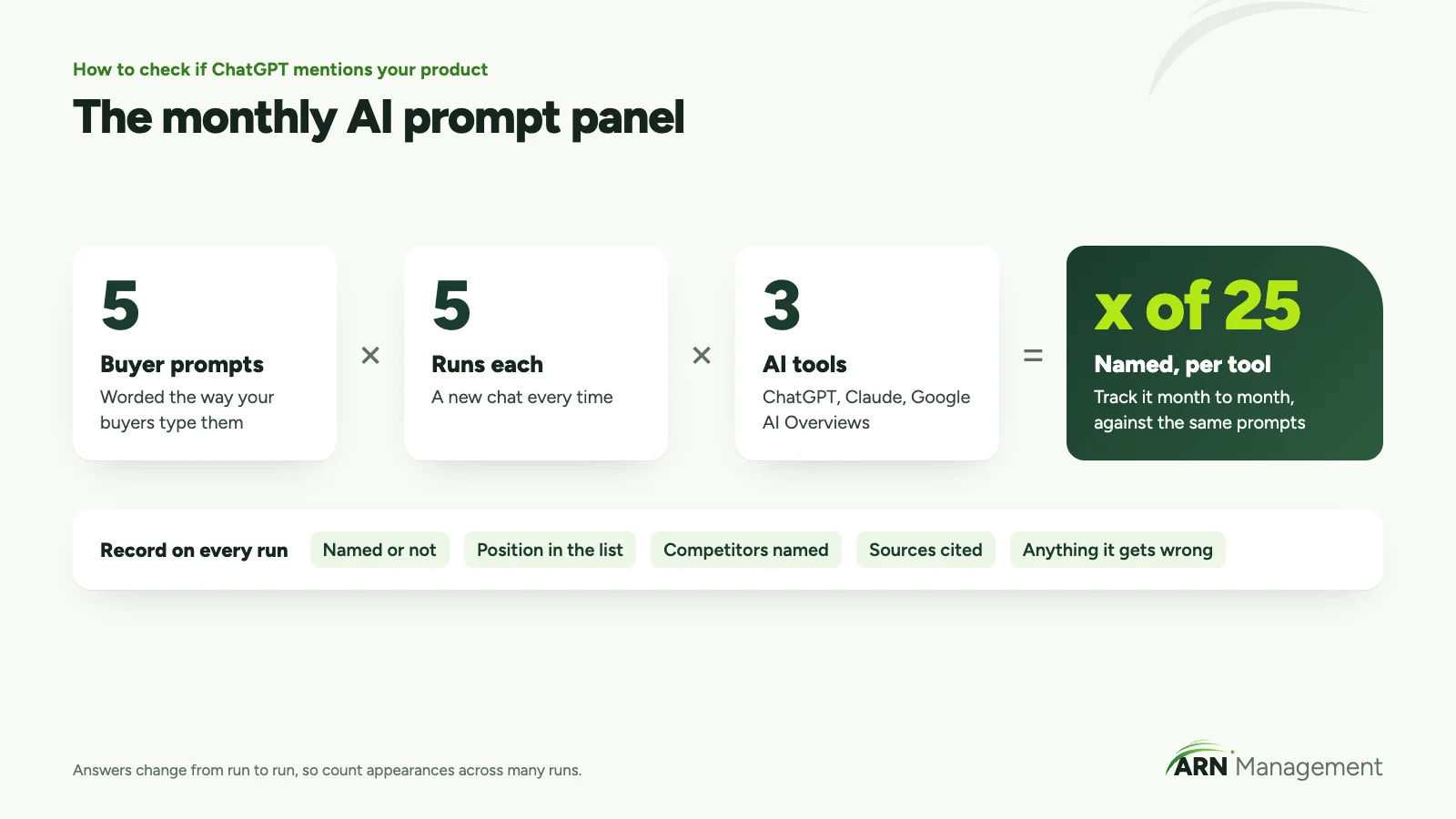
- Fix the prompts. Use your 5 buyer questions, worded as a buyer would type them.
- Run each prompt 5 times in each tool. Use ChatGPT, Claude and Google AI Overviews, and start a new chat each time.
- Record 5 things per run. Whether you are named, your position in the list, the competitors named, the sources cited, and anything the answer gets wrong about you.
- Score it. Write "named x of 25" for each tool. That number, tracked month to month, is more useful than any single answer.
- Fix the errors at the source. If an answer describes your product wrongly, find the page it cited and correct your own page, your review profile or the listing behind it.
What did ClinicianCore's AI Overview citations show?
ClinicianCore's AI Overview citations showed that a new health tech company can be cited by Google's AI for specific searches within its first year. ARN built ClinicianCore's digital presence from no rankings and no citations, and the company earned 4 Google AI Overview citations 16.
- Physician Burnout Reduction Platform. ClinicianCore held the #1 organic position and was the primary source in Google's AI Overview.
- Unified Clinical Communication. Google's AI Overview cited ClinicianCore for this category term.
- HIPAA Compliant Collaboration. ClinicianCore was the only source cited in the AI Overview.
In the same 3-month Search Console comparison, impressions grew from 7.78K to 39.7K (+410%) and clicks from 60 to 150 16. The work combined answer-first pages, specific searches and named physician voices. ARN cannot say which step earned which citation, and no one can promise a citation. The full ClinicianCore case study shows the method, and our portfolio shows results for other clients 17.
How do you measure AI recommendations?
Measure AI recommendations by starting with demos booked and working back to the AI visibility behind them. Review 4 things each month.
- Demos and inbound leads. Ask new leads how they found you, and add "an AI tool" as an answer option on your forms.
- Google. Search Console's generative AI reports show your impressions in AI features on Search 18.
- Microsoft. Bing Webmaster Tools' AI Performance report shows how your content appears in Copilot and Bing's AI summaries 19.
- Your prompt panel. The "named x of 25" score for each tool, against last month's.
AI tools send far fewer visits than Google today, so read the panel and the demo count together.
How long does it take to get recommended by AI tools?
Getting recommended by AI tools can take weeks for a specific question and months for a competitive category. AI visibility can move sooner than rankings when a page already answers the question clearly and other sites mention you. No one can promise a date, and answers keep changing, so plan for a monthly routine.
What should a health tech company skip?
A health tech company can skip the shortcuts that promise AI visibility without better pages. Google says you do not need new machine-readable files, AI text files or special schema to appear in its AI features, and it treats pages made mainly to manipulate AI responses as spam 10.
- llms.txt as a ranking tactic. It is optional and harmless. Google Search does not use it.
- Hundreds of near-identical pages. One strong page per buyer question does more.
- Paid or self-written "best of" lists. Earn places on lists that buyers already trust.
- Anyone who promises a ChatGPT recommendation. No agency controls what an AI model answers.
ARN is a healthcare marketing agency in Atlanta for health tech companies and medical practices, and builds the search presence of health tech that sells to practices. Answer engine optimization works best on top of a strong healthcare SaaS SEO plan, and our guide on health tech marketing strategy shows where it fits in a 90-day plan.
Frequently asked questions
Can ChatGPT recommend my software product?
ChatGPT can recommend your software product when it finds clear pages about it and consistent mentions on other trusted sites. It searches the web for many buyer questions, so your pages must be open to OAI-SearchBot and answer the question in plain words. No one can make ChatGPT name a product, and its answers change from run to run, so check them often.
How do I check if ChatGPT mentions my company?
Ask ChatGPT 5 questions your buyers would ask, 5 times each, starting a new chat each time, and record whether your company is named, in what position, and which sources are cited. Repeat the same prompts in Claude and Google AI Overviews. Track the result as "named x of 25" per tool, month to month.
Do G2 and Capterra reviews affect AI recommendations?
G2 and Capterra reviews can affect AI recommendations, because AI tools draw heavily on third-party sources when they compare software. Review profiles give an AI tool independent descriptions of your product, your buyers and your strengths. Ask real customers for reviews on the platforms your buyers use, and keep your profile's product description the same as your website's.
Should I block GPTBot to protect my content?
You can block GPTBot without leaving ChatGPT search, because OpenAI uses separate crawlers for training and for search. GPTBot collects training data. OAI-SearchBot decides whether your pages can be shown in ChatGPT search answers, and OpenAI says sites that opt out of it will not appear there. Decide on training and on search separately.
Why does ChatGPT give a different answer every time?
ChatGPT gives a different answer every time because it writes each answer fresh, often after running several new searches. In one study of 2,961 prompts, ChatGPT and Google's AI returned the same list of brands less than 1 time in 100. That is why a single check proves little, and why you should count appearances across many runs.
How do I fix wrong information AI gives about my company?
To fix wrong information AI gives about your company, find the source it cited and correct the facts there. Update your own page first, then your review profiles, directory listings and partner pages, so every source says the same thing. Check the same prompt again over the following weeks, because AI tools refresh their sources at different speeds.
Written by
Naman JhaPresident, ARN Management Consulting, LLC
Digital strategist, web architect and AI leader with a B.S. in Computer Science. Naman is President of ARN Management Consulting, LLC, which he founded on the conviction that technology, design and strategy must work as one to drive real market outcomes. In 7+ years of strategic leadership he has delivered 100+ platforms across 150+ client relationships, spanning enterprise web architecture, AI-driven automation and brand positioning. Every initiative he leads is tied to business performance.
References
- 51% of B2B software buyers now start their research with an AI chatbot more often than with Google (survey of 1,076 buyers, March 2026). Source: G2, In the Answer Economy, Don't Win the Click, Win the Answer, 2026
- There are no additional requirements to appear in AI Overviews or AI Mode, nor other special optimizations necessary; SEO best practices remain relevant. Source: Google Search Central, AI features and your website, accessed 2026
- More than 80% of physicians use AI professionally, more than double the rate when the AMA first asked in 2023 (nearly 1,700 physicians surveyed). Source: American Medical Association, More than 80% of physicians use AI professionally: AMA survey, 2026
- 42.2% of physicians worked in private practice in 2024, down from 60.1% in 2012. 34.5% worked in hospital-owned practices. Source: American Medical Association, Smaller share of doctors in private practice than ever before, 2025
- Across 750 top-of-funnel prompts about software, products and agencies, "best X" blog lists were 43.8% of all page types cited by ChatGPT. Source: Ahrefs, "Best" lists research, 2025
- AI search showed a systematic bias toward earned media (third-party sources) over brand-owned and social content. Source: Chen, Wang, Chen and Koudas, Generative Engine Optimization (arXiv preprint), 2025
- Across 75,000 brands, branded web mentions showed the strongest correlation with AI Overview brand visibility (0.664); backlinks correlated at 0.218. Correlation only. Source: Ahrefs, brand correlations with AI Overview visibility, 2025
- OAI-SearchBot is OpenAI's search crawler. Sites that are opted out of OAI-SearchBot will not be shown in ChatGPT search answers. GPTBot is a separate crawler used for training. Source: OpenAI, Overview of OpenAI crawlers, accessed 2026
- Claude-SearchBot navigates the web to improve search result quality for Claude users; blocking it may reduce a site's visibility in Claude's answers. Source: Anthropic, Does Anthropic crawl data from the web, and how can site owners block the crawler?, accessed 2026
- Site owners do not need new machine-readable files, AI text files, special schema.org markup or content split into tiny pieces to appear in Google's generative AI features. Pages made primarily to manipulate rankings or generative AI responses violate Google's scaled content abuse policy. Source: Google Search Central, Optimizing your website for generative AI features on Google Search, 2026
- Google asks "Who, How, and Why" about content, asks for bylines that lead to author information, and calls fabricated creator profiles (AI-generated headshots, made-up names, false credentials) a form of deception. Source: Google Search Central, Creating helpful, reliable, people-first content, 2026
- URLs cited by AI assistants were on average 1,064 days old, against 1,432 days for URLs in organic search results: about 25.7% fresher (about 17 million citations). Source: Ahrefs, Do AI assistants prefer to cite fresh content?, 2025
- 1,885 pages that added JSON-LD schema, compared with about 4,000 matched pages, showed no significant uplift in AI citations: AI Mode +2.4%, ChatGPT +2.2% (both not significant), AI Overviews -4.6%. Source: Ahrefs, Does schema help you get cited by AI?, 2026
- Across 2,961 prompts run 60 to 100 times each, ChatGPT and Google's AI returned the same list of brands less than 1 time in 100, and the same list in the same order less than 0.1% of the time. Source: Search Engine Journal, AI recommendations change with nearly every query: SparkToro, 2026
- Over 17 weeks and 82,619 prompts, ChatGPT replaced as much as 74% of its cited domains each week and Google AI Mode 56%; AI Overviews were the most stable. Source: SISTRIX, AI citation drift, 2026
- ClinicianCore: impressions 7.78K to 39.7K (+410%) and clicks 60 to 150 in a 3-month Search Console comparison; 4 Google AI Overview citations, including "Physician Burnout Reduction Platform" (#1 organic and the primary AI Overview source), "Unified Clinical Communication" and "HIPAA Compliant Collaboration" (the sole AI Overview citation). Source: ARN Management, ClinicianCore case study, 2026
- Published SEO results: SafeData Solutions (B2B data security) +218% organic traffic; Q Sine Energy (energy solutions) top 3 on 12 keywords. Source: ARN Management, Portfolios, 2026
- Search Console's generative AI performance reports give dedicated views of a site's impressions within generative AI features on Search. Source: Google Search Central Blog, Introducing Search Generative AI performance reports in Search Console, 2026
- Bing Webmaster Tools' AI Performance report shows how publisher content appears across Microsoft Copilot, AI-generated summaries in Bing and select partner integrations. Source: Microsoft Bing Webmaster Blog, Introducing AI Performance in Bing Webmaster Tools, 2026
All links checked: November 24, 2026.
Free AI Visibility Audit: arnmanagement.com/ai-visibility-audit/ · (770) 678-2040 · info@arnmanagement.com