You are paying for SEO. Your rankings look fine. But when a potential patient or buyer asks ChatGPT for the best provider in your space, your name never comes up. That gap is the whole story of search in 2026. Three letters keep showing up in the conversation: SEO, AEO, and GEO. Most business owners cannot explain the difference, and many of the agencies pitching them cannot either. This guide breaks down the SEO, GEO, and AEO difference in plain English, shows how the three fit together, and tells you which one to prioritize first so you stop leaving qualified leads on the table.
What is the Difference Between SEO, GEO, and AEO?
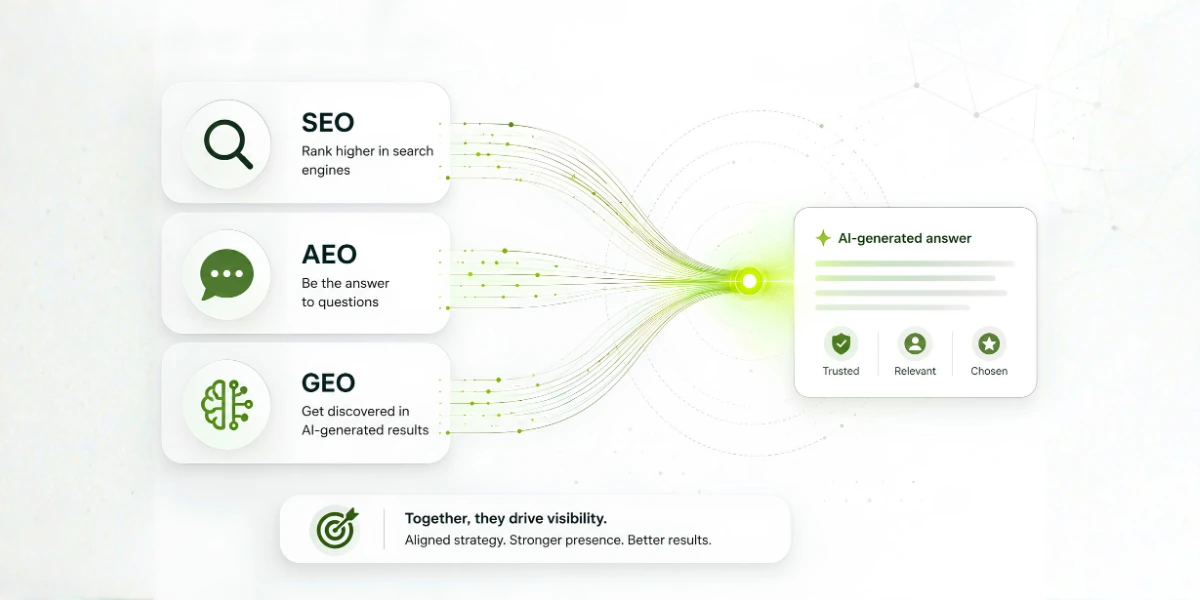
SEO, AEO, and GEO are three ways to get found online, each aimed at a different system. SEO optimizes your site to rank in search engine results. AEO structures your content to win the direct answer, such as featured snippets and voice results. GEO shapes your content so generative AI tools cite it inside the answers they write.
For a growing business, the practical takeaway is simple. SEO earns the click. AEO earns the answer box. GEO earns a mention when an AI tool recommends a provider. The table below shows how they line up.
What Is the Difference Between SEO, GEO, and AEO?
| Dimension | SEO | AEO | GEO |
|---|---|---|---|
| Full name | Search Engine Optimization | Answer Engine Optimization | Generative Engine Optimization |
| Optimizes for | Ranking in search results | Winning the direct answer | Getting cited in AI answers |
| Shows up in | Google and Bing results pages | Featured snippets, voice, AI Overviews | ChatGPT, Perplexity, Gemini, Copilot, Claude |
| The goal | Earn the click | Be the answer | Be the source the AI quotes |
| How you win | Authority, keywords, technical health, links | Clear question-and-answer structure, schema | Citable facts, entity signals, third-party mentions |
| Success metric | Rankings and organic traffic | Snippet and answer ownership | Citation frequency and brand mentions |
The three overlap, but they are not interchangeable. Optimizing for one does not automatically win the others, which is why a one-size strategy leaves visibility on the table.
Why the SEO, GEO, and AEO Difference Matters in 2026
The difference matters because the click you used to count on is disappearing. Search engines now answer many questions on the results page itself, and a growing share of buyers ask an AI tool before they ever reach Google. If your content is not built for both, you lose visibility even when your rankings look healthy.
The data is hard to ignore. According to Ahrefs, the presence of a Google AI Overview correlated with a 58% lower average click-through rate for the top-ranking page in its December 2025 analysis, up from 34.5% earlier in 2025 (2026). The top spot is still the top spot. It just sends far fewer visitors than it used to.
The shift is sharpest in healthcare. According to Search Engine Journal, healthcare queries triggered a Google AI Overview about 88% of the time by December 2025, with AI Overview coverage growing 58% year over year (2026). If you run a practice or a health-tech platform, AI answers are already standing between you and most of your searchers.
At the same time, buyers are arriving straight from AI tools. According to Semrush, outbound referral traffic from ChatGPT grew 206% in 2025 (2026). That traffic tends to convert well, because the visitor has already done their research inside the AI tool before they click.
Gartner has predicted that traditional search engine volume will drop 25% by 2026 as people shift to AI chatbots and virtual agents (Gartner, 2024). Treat that as a forecast, not a measured result. Gartner has described the figure as scenario modeling, and the real-world numbers are still settling. We flag it honestly because the direction it points to already shows up in the measured data above.
Do You Need All Three? How SEO, AEO, and GEO Work Together
Yes, and they are not competing budgets. They are layers of one strategy. SEO builds the authority that makes your content eligible to be cited. AEO structures that content so engines can lift a clean answer. GEO makes sure AI tools surface your brand when they generate that answer. Skip a layer and the others underperform.
These layers compound. AI engines lean heavily on content that already ranks well, so a strong SEO services foundation feeds your AI citation odds rather than competing with them. Our generative engine optimization guide covers the citation side in depth, and our answer engine optimization page explains the schema and answer-structure work that wins the snippet. Run them together and each layer raises the ceiling of the next.
The mistake we see most often is treating GEO as a replacement for SEO. It is not. The brands getting cited by AI are usually the ones that already earned organic authority. Pull the SEO foundation out and the AI citations dry up with it.
Which Should You Focus on First?
Start with the layer that strengthens the others. For most growing businesses, that means a solid SEO foundation first, then AEO structure on top, then GEO signals. Fix technical health and content authority early, because AI engines pull so heavily from content that already ranks. If you operate in a category where AI answers already dominate, like healthcare, move on GEO and AEO sooner rather than later.
This is the order we used with ClinicianCore, a HIPAA-compliant physician communication platform we work with. We built the SEO and content foundation first, structured the high-intent pages for clean answer extraction, then layered GEO signals so AI tools would surface the brand. We measure that work in business outcomes only: organic visibility, AI citations, and qualified inbound, never clinical results.
If you are weighing where to put the next dollar, the honest answer depends on your starting point. A business with weak organic authority should fix SEO first. A business that already ranks but stays invisible in AI answers should move budget into AEO and GEO now. A quick audit tells you which camp you are in.
Frequently Asked Questions
What is the difference between GEO, AEO, and SEO?
SEO gets your site to rank in search engine results so people click through to you. AEO structures your content to win the direct answer, like a featured snippet or a voice result. GEO shapes your content so generative AI tools such as ChatGPT and Perplexity cite it inside the answers they write. SEO earns the click, AEO earns the answer, and GEO earns the AI mention.
Do I need all three, or can I just do SEO?
You need all three, because they target different systems and they compound. SEO on its own still earns rankings, but a growing share of buyers never reach a results page. They get their answer from an AI Overview or a chatbot first. AEO and GEO make sure your business shows up in those answers. Doing only SEO in 2026 leaves a large and growing slice of demand uncaptured.
Which should I focus on first?
Focus on the layer that strengthens the others. For most growing businesses, that is a strong SEO foundation first, then AEO structure, then GEO signals. AI engines pull heavily from content that already ranks, so SEO raises your AI citation odds. The exception is a category where AI answers already dominate, such as healthcare, where moving on GEO and AEO sooner is worth it.
Is GEO the same as AEO?
They are closely related and the terms are often used loosely, but they are not identical. AEO focuses on winning a direct answer, including featured snippets, voice results, and Google AI Overviews. GEO focuses on getting cited inside the longer answers that generative AI tools write. AEO is about being the answer. GEO is about being the source the AI quotes. A complete strategy covers both.
Does traditional SEO still matter in 2026?
Yes, and it may matter more than ever. AI tools rely on the open web for the facts they cite, and they favor content that already ranks well. Strong SEO is what makes your pages eligible to be quoted in the first place. The change is not that SEO died. The change is that ranking is now the floor, not the finish line. You build on it with AEO and GEO.