Your business is showing up on Google. But when a potential client asks ChatGPT or Perplexity which digital strategy consultant can help their medical practice grow, your name is not in the answer. That is not a content problem. That is an answer engine optimization problem.
According to Search Engine Land, AI-referred web sessions grew 527% year-over-year from January to May 2024 compared to the same period in 2025. At the same time, a 2026 study published by Search Engine Land found that 37% of consumers now start their searches with AI tools instead of Google. If your content strategy does not account for how AI engines select and cite sources, you are invisible to a growing share of your market before they ever find your website.
This guide explains exactly what answer engine optimization is, how it differs from traditional SEO, and the specific steps growing businesses and healthcare operators can take to start getting cited by ChatGPT, Perplexity, and Google AI Overviews in 2026.
What Is Answer Engine Optimization?
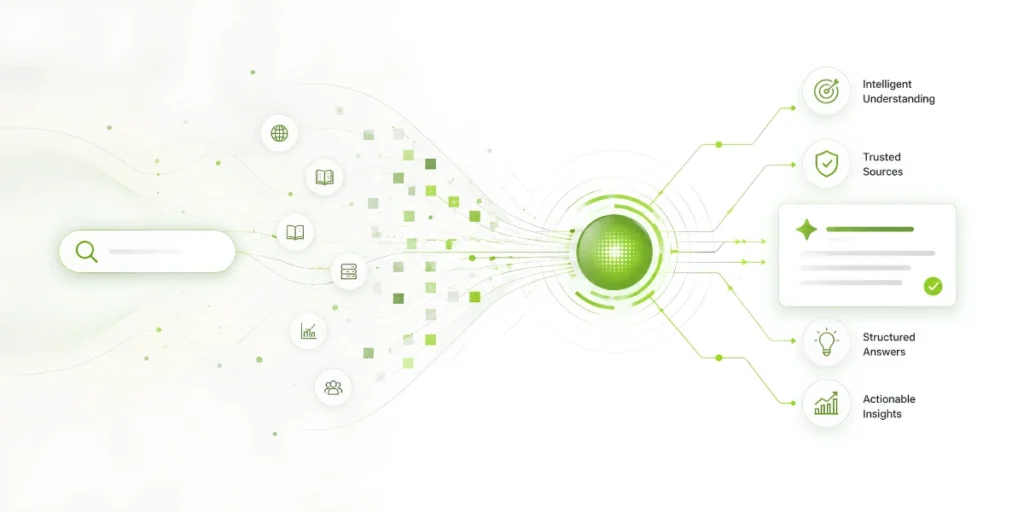
Answer engine optimization (AEO) is the practice of structuring and formatting your content so that AI-powered platforms select it as a cited source when generating answers to user queries. Instead of optimizing to rank in a list of blue links, AEO optimizes your content to become the answer itself, extracted and credited by systems like ChatGPT, Perplexity, and Google AI Overviews.
For growth-stage founders and healthcare operators, this distinction matters in practical terms. When a physician or healthcare executive asks ChatGPT “which digital strategy firm specializes in medical practice SEO,” the AI synthesizes an answer from multiple web sources and cites the ones it finds most credible, structured, and relevant. AEO is the work of making sure your content meets those criteria so your brand appears in that answer.
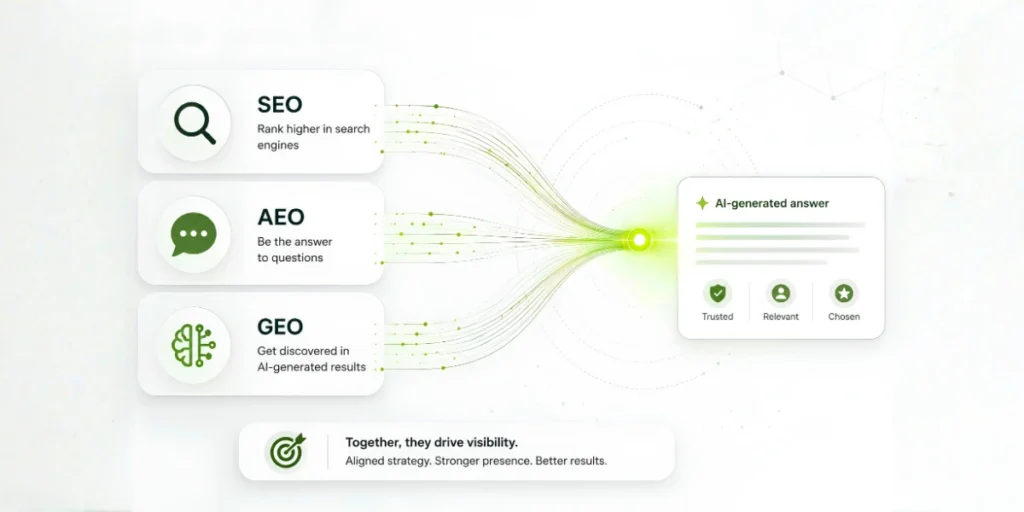
AEO sits within the broader discipline of Generative Engine Optimization (GEO). While GEO covers all strategies for improving visibility across generative AI platforms, AEO focuses specifically on the answer-retrieval layer: ensuring your content provides clear, citable facts and structured responses that AI engines can extract with confidence
Why This Matters Now
The scale of the shift is real and measurable. According to OpenAI, ChatGPT reached 900 million weekly active users in February 2026. In healthcare specifically, research published by Search Engine Journal found that Google AI Overviews now appear on 88% of healthcare-related search queries as of December 2025. For a physician practice or healthcare SaaS platform, that means the vast majority of your potential clients are encountering AI-generated answers before they ever see your website.
Gartner predicted in February 2024 that traditional search engine volume would drop 25% by 2026 due to AI chatbots and virtual agents. That forecast is playing out in traffic data: the question for growing businesses is not whether to optimize for AI engines, but how quickly they can build the content structure that earns citations.
AEO vs. SEO: What Actually Differs
AEO and traditional SEO share the same foundation: high-quality, authoritative, well-structured content. The difference is in what each discipline optimizes for and how it measures success. Both are required for full search visibility in 2026.
The table below shows the key distinctions. Neither replaces the other. SEO gets your content indexed and discovered. AEO adds the structure AI engines need to extract and cite your answers.
AEO vs. SEO: What Actually Differs
| Dimension | Traditional SEO | Answer Engine Optimization |
|---|---|---|
| Primary goal | Rank higher to earn clicks | Get cited in AI-generated answers |
| Success metric | Rankings, organic traffic, CTR | AI citations, brand mentions in AI answers |
| Content unit | Page-level keyword targeting | Fact-level, extractable answer blocks |
| Query style | 2-4 word keyword phrases | Conversational, question-based (10-25+ words) |
| Schema focus | Title tags, meta, alt text | FAQPage, Article, Person, BreadcrumbList |
| Freshness signal | Periodic updates | Continuous freshness (AI prefers recent content) |
| Citation type | Backlinks to your page | AI engines extract and cite your content directly |
The Core Difference in Execution
Traditional SEO asks: “Is this page ranked for the right keywords?” AEO asks: “Can an AI engine extract a clear, citable answer from every section of this page?” A page can rank in the top three on Google and still be ignored by AI engines if it buries its answers inside long paragraphs, uses vague language, or lacks schema markup.
The structural requirement for AEO is specific. Every section of your content should open with a 2-3 sentence direct answer to the question that section addresses. Every FAQ answer should be self-contained in 40 to 100 words. Every definition should be 40 to 60 words of plain English that makes sense if read without any surrounding context. These are the passages AI engines extract. If they are not in your content, your content does not get cited.
How AI Engines Actually Retrieve and Cite Content
Most AI platforms use a process called Retrieval-Augmented Generation (RAG). When a user submits a question, the AI breaks it into smaller sub-queries, searches the web for relevant content, ranks candidate pages on relevance, authority, and structural quality, then synthesizes an answer and attributes specific claims to source documents.
A key implication for your content: your pages need to rank for the shorter sub-queries the AI generates from a user’s original question, not just the question itself. If someone asks ChatGPT “what marketing strategy should my physician practice use in 2026,” the AI might search “digital strategy for medical practices,” “SEO for physician practices,” and “how to get healthcare leads online” as separate retrieval queries. Your content needs to be structured to surface for each of those sub-queries.
The AEO Architecture: Five Elements That Drive AI Citations
Getting cited by AI engines is not a function of one optimization tactic. It is the result of building your content and digital presence around five specific elements that AI systems use to select and trust sources. ARN Management Consulting applies this architecture to every content piece we produce for clients.
1. The Direct-Answer Block
Every section of your content should open with a direct answer to the question that section addresses. Not a teaser. Not context-setting. The answer itself, in 40 to 60 words of plain English.
AI engines are trained to extract the most concise, complete response to a query. If your content buries the answer in paragraph three after two paragraphs of setup, the AI skips past your page. If your content leads with the answer and follows with supporting evidence, it becomes a reliable citation source.
This is also the passage that appears in Google AI Overviews when your content is selected. Write it as if it needs to stand completely alone, because in many AI contexts, it will.
2. FAQPage Schema
FAQPage schema is the single highest-impact technical implementation for AEO. It tells AI engines exactly where your questions and answers are, what each question says, and what your answer contains, without requiring any inference from natural language processing.
The technical implementation is straightforward. Each FAQ entry in your schema should match the visible FAQ section in your article. Questions should mirror real queries from People Also Ask boxes, Reddit threads, and AI query research. Answers should be 40 to 100 words each. This range consistently produces the most AI-extracted responses: long enough to be substantive, short enough not to be truncated.
FAQPage schema remains valid for AI parsing in 2026. Google deprecated FAQ-rich results in search in May 2026, but the schema continues to function as a structured signal for AI engines that are reading your content. This is a distinction that many competitors are getting wrong. Removing FAQPage schema because rich results are deprecated removes a direct citation signal from AI engines that rely on it.
3. Article and Person Schema
AI engines factor in authorship and organizational credibility when selecting citation sources. Article schema with a named author tied to a Person schema entry tells the AI that this content was produced by a real, identified expert with verifiable credentials, not generated anonymously at scale.
For ARN clients, this means every article published under Naman Jha’s byline should include Person schema listing his title, the organization he leads, and a URL linking to his author page. For healthcare operators, this is doubly important: AI engines apply higher scrutiny to healthcare content and weight E-E-A-T signals more heavily in that domain.
4. Verified Statistics with Inline Attribution
Content with verified statistics sees measurably higher AI citation rates. The mechanism is logical: AI engines are selecting passages to synthesize into authoritative answers. A passage with a specific, sourced statistic is more citable than a vague assertion. AI systems are also trained to prefer content that models the behavior of good sourcing.
The implementation rule is strict at ARN: every statistic must trace to a primary approved source with a live URL. The citation format is inline: “According to [Source], [Stat] ([Year]).” Not a footnote. Not a general reference. An inline attribution with the source name hyperlinked to the source URL, inside the body of the relevant paragraph.
5. Content Freshness
AI engines favor recently updated content. Research analyzing AI-cited URLs found they are consistently fresher than URLs returned by traditional Google search for the same queries. For high-intent or commercial queries, the effect is more pronounced.
For growing businesses, this means building a content refresh cadence into your editorial calendar. Pillar pages should be reviewed every 90 days. Statistics should be updated when newer figures are available. The dateModified field in your Article schema should reflect the actual refresh date, not the original publish date.
AEO for Healthcare Operators: Why the Opportunity is Larger Than You Think
Healthcare is one of the fastest-growing verticals for AI search queries, and it is also one of the least competitive for AEO. Most healthcare providers are still optimizing primarily for traditional Google rankings. Almost none have implemented the AEO content structure that earns citations from AI engines.
The Healthcare AI Search Reality
Research published by Search Engine Journal, based on BrightEdge data, found that Google AI Overviews appear on 88% of healthcare-related search queries as of December 2025, up from 72% in 2024. This means that for nearly every healthcare search query, the person conducting that search is encountering an AI-generated answer before they ever see a list of websites.
The implication for physician practices, clinical SaaS platforms, and healthcare-adjacent businesses is direct: if your content is not structured for AI citation, you are invisible at the most critical point in the patient or client acquisition journey. The competitor who does implement AEO structure earns the citation slot in that AI Overview. That citation earns more clicks, more brand recognition, and more inbound inquiries than any non-cited organic result on the same page.
What Healthcare AEO Looks Like in Practice
ClinicianCore, a HIPAA-compliant physician communication platform in ARN’s portfolio, implemented AEO-optimized content structure as part of a broader digital strategy engagement. The work involved restructuring service and educational pages around direct-answer blocks, implementing FAQPage and Article schema with physician-authored attribution, and building a distribution plan that extended content to Reddit healthcare communities and Quora.
The structural changes that produced the strongest AI citation results were the same as in any other industry: opening each section with a direct answer, keeping FAQ responses under 100 words, and ensuring every claim in the content traced to a primary source. What was different for healthcare was the emphasis on YMYL (Your Money or Your Life) E-E-A-T signals: author credentials needed to be verifiable, and the content needed to consistently frame outcomes as business results rather than clinical claims.
The healthcare angle that no page-1 AEO competitor currently covers: physician-founded organizations and clinical SaaS platforms face YMYL content standards. AI engines are more selective about healthcare citations precisely because the stakes are higher. This means healthcare operators who invest in AEO correctly, with verified sourcing, named authorship, and schema, capture a citation market that commodity content cannot enter. It is a structural advantage for businesses that are serious about doing it right.
How to Measure AEO Performance
AEO performance is not measured by keyword rankings alone. It requires tracking your presence across the AI engines where your clients are conducting research. The metrics that matter are brand mention frequency in AI-generated answers, direct citation links from platforms like Perplexity, and AI-referred sessions in your analytics.
Starting Measurements
Query ChatGPT, Perplexity, and Google AI Mode with the questions your ideal clients are asking. Record which sources are cited. If your content appears, note which passage was extracted. If it does not appear, compare the cited pages against your content to identify structural gaps: are they leading with direct-answer blocks? Do they have FAQPage schema? Are their statistics verified and cited inline?
AI-referred traffic in Google Analytics is tracked under the referral source. ChatGPT referrals appear as chatgpt.com. Perplexity appears as perplexity.ai. According to Semrush research published in 2025, AI-referred visitors convert at 4.4 times the rate of traditional organic search visitors. This means even small volumes of AI referral traffic can produce meaningful business results.
The 90-Day Benchmark
AEO improvements take 5 to 9 months to show consistent citation frequency, similar to the timeline for traditional SEO on competitive keywords. The first 90 days should focus on building the structural foundation: direct-answer blocks across all key pages, FAQPage schema implemented and validated, Article and Person schema confirmed, and statistics inventory completed and cited inline. Schema validation should run through Google’s Rich Results Test after every publish.
Frequently Asked Questions
What is answer engine optimization (AEO)?
Answer engine optimization (AEO) is the practice of structuring and formatting your content so that AI-powered platforms, including ChatGPT, Perplexity, and Google AI Overviews, select it as a cited source when generating answers to user queries. AEO differs from traditional SEO in that it optimizes for citation and extraction, not just for ranking position on search results pages.
How do I get my business cited by ChatGPT?
To get cited by ChatGPT, structure your content around direct-answer blocks of 40 to 60 words at the opening of each section, implement FAQPage and Article schema on every page, cite verified statistics with inline attribution, and keep FAQ answers between 40 and 100 words. ChatGPT uses a retrieval process that favors structured, authoritative, recently updated content with clear named authorship.
Is AEO the same as SEO?
AEO and SEO are related but not the same. Traditional SEO optimizes for ranking position and click-through rate on search results pages. AEO optimizes for being selected and cited by AI engines that generate direct answers. Both are required for full search visibility. SEO gets your content indexed and discovered. AEO adds the structure AI engines need to extract and cite specific passages from your content.
What schema markup do I need for AI search?
For AI search visibility, the highest-priority schema types are FAQPage (for extractable question-and-answer pairs), Article (to attribute content to a named author with verifiable credentials), Person (for the named author), and BreadcrumbList (for site structure context). Implement all four as JSON-LD in every article. FAQPage schema remains a valid AI citation signal in 2026 even though Google deprecated FAQ-rich results in traditional search.
Why is AI recommending my competitors but not my business?
AI engines cite sources that meet specific structural criteria: direct-answer paragraphs at the opening of each section, FAQPage schema that explicitly marks up question-answer pairs, verified statistics with inline attribution, and content freshness signals. If competitors appear in AI answers and you do not, they have likely implemented these structural elements. Auditing their content against these criteria identifies exactly what your content is missing.
How long does AEO take to show results?
AEO improvements typically take 5 to 9 months to produce consistent citation frequency across AI platforms, similar to the timeline for competitive SEO. Schema validation and structural changes can produce early citation appearances within 30 to 60 days on lower-competition queries. Building reliable citation authority across high-competition queries in your niche requires a sustained content and distribution program.
Does AEO work differently for healthcare businesses?
AEO for healthcare businesses requires additional attention to E-E-A-T signals because healthcare content is subject to YMYL (Your Money or Your Life) standards. AI engines are more selective about healthcare citations and weigh author credentials, verified sourcing, and organizational authority more heavily. Healthcare operators who implement AEO correctly gain a structural advantage over competitors who rely on unattributed or generically written content.