Your rankings held. Your content did not change. But your organic traffic dropped 30% last quarter. If that is familiar, you are not dealing with a SEO problem. You are dealing with a structural shift in how AI search marketing in 2026 works. And in 2026, business owners who do not understand this shift are handing their visibility to competitors who do.
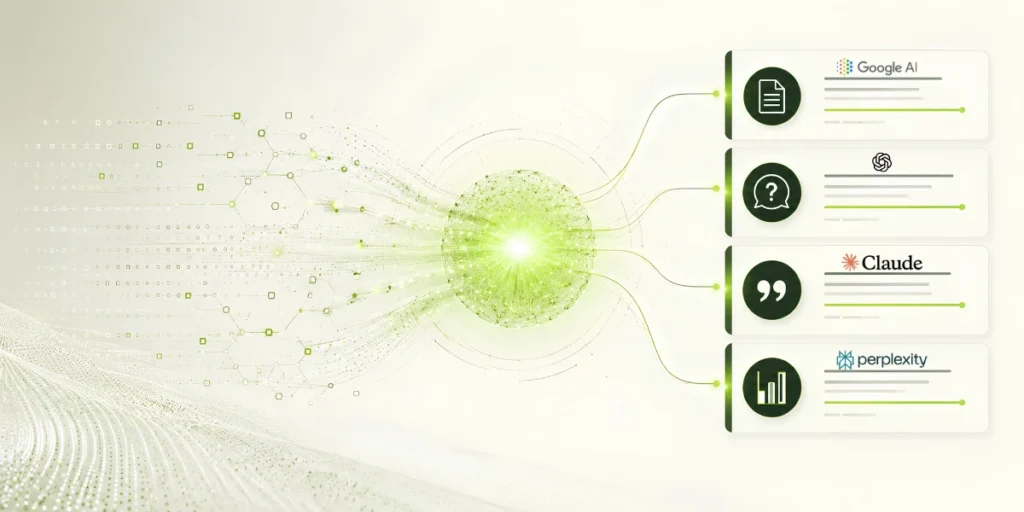
Search has been redesigned around AI. Google AI Overviews, ChatGPT search, Perplexity, and Gemini now intercept your buyers before they ever reach your website. The businesses that adapt their digital strategy to this new reality will compound their visibility. The ones that keep running the same playbook will keep watching their traffic disappear and wonder why their rankings look fine.
This guide breaks down exactly what changed, what it means for growth-stage businesses and healthcare operators in particular, and the specific moves ARN Management Consulting recommends for 2026.
Key Takeaways
- Rankings no longer equal traffic – Ahrefs found a 58% lower click-through rate on the top-ranking organic result when a Google AI Overview is present. Your position held. Your clicks did not.
- Healthcare buyers are already using AI to find providers – 70% of patients are open to using AI tools to research physicians (RLDatix, 2026). Physician AI adoption rose from 47% to 63% in less than a year (Doximity, 2026). If your practice or platform is not appearing in AI answers, a competitor is.
- AI citation is a different game from SEO – AI engines select sources based on structured content, entity consistency, FAQPage schema, named author credentials, and cross-platform brand presence. Ranking signals and citation signals overlap but are not identical.
- The three-strategy stack is now the baseline – SEO gets you found in traditional search. AEO gets specific passages cited by AI engines. GEO gets your brand consistently recommended. All three run simultaneously. Dropping any one of them leaves a gap competitors will fill.
- The window is open; but not indefinitely – Most growth-stage businesses and healthcare operators have not yet adapted to AI search. The businesses that build citation authority in 2026 will hold a structural advantage that compounds. The analogy is SEO in 2014.
Ranking #1 on Google no longer guarantees traffic.
Being cited inside an AI answer does.

What Is AI Search and Why Does It Change Everything?
AI search is the practice of using large language models, including ChatGPT, Google AI Overviews, Perplexity, and Microsoft Copilot, to answer user queries directly in the interface rather than returning a list of links to click. Instead of sending users to your website, AI search synthesizes an answer from multiple sources and delivers it in plain language, often without the user ever visiting any external page.
For business owners, this changes the fundamental equation of digital visibility. Ranking #1 on Google no longer guarantees traffic. Being cited inside an AI answer does.
The data makes the magnitude clear. According to Ahrefs (February 2026), the presence of a Google AI Overview on a search results page correlates with a 58% lower click-through rate on the top-ranking organic result. A position you spent months building now delivers less than half the traffic it would have generated in 2024.
At the same time, AI search platforms are growing as traffic referrers. Semrush’s analysis of more than 1 billion lines of U.S. clickstream data found that outbound referral traffic from ChatGPT to external websites grew 206% from January 2025 to January 2026. That traffic, while still a fraction of overall volume, converts at significantly higher rates than standard organic sessions, because users arrive having already researched through AI.
The shift is structural, not cyclical. Building a search strategy that accounts for both traditional rankings and AI citation is no longer optional for businesses that rely on digital discovery.
Why This Matters Specifically for Growth-Stage Businesses
Most coverage of AI search focuses on publishers and large e-commerce brands. But growth-stage founders and healthcare operators face a distinct version of this challenge, and it has gone largely unaddressed.
Healthcare and Clinical Operators: Your Buyers Are Asking AI First
Search behavior in healthcare has changed faster than in most industries. According to RLDatix (April 2026), 70% of patients are now open to using AI tools to research physicians. That means seven out of ten prospective patients or referral sources may be forming their first impression of your practice or platform through a ChatGPT or Perplexity answer, not through your website.
Among physicians themselves, the shift is equally striking. The Doximity State of AI in Medicine Report 2026 found that physician AI adoption rose from 47% to 63% in less than a year, with 94% of physicians surveyed saying they are currently using AI or are interested in doing so. Healthcare SaaS platforms and clinical tools that want to reach these buyers need to appear in AI answers, not just search rankings.
The traffic consequences are already visible. Semrush’s 2025 traffic channel analysis found that healthcare was among the industries with the steepest organic search traffic decline, dropping 30.09% across 2025, a shift largely attributed to the prevalence of AI Overviews on health-related queries.
Growing Businesses: You Are Competing Against Brands That Got to AI First
AI engines do not recommend based on size. They recommend based on structured authority signals: consistent entity mentions, high-quality citations across credible sources, structured schema data, and content that answers questions directly. A well-structured, AI-optimized independent practice or founder-led brand can appear in AI answers ahead of far larger competitors.
The window to establish that position is open right now. Gartner’s 2024 forecast predicted that traditional search engine volume could drop 25% by 2026 as AI chatbots and virtual agents capture an increasing share of queries. That is a prediction, not a confirmed measurement, and analysts at Search Engine Journal have questioned the timeline. But the directional shift is real. Businesses that build AI citation authority in 2026 will have a structural advantage that compounds over time.
How AI Search Engines Decide What to Cite
Understanding how AI search selects sources is the first step to appearing in those answers. The mechanics differ meaningfully from traditional Google ranking.
Traditional SEO ranked pages based on backlinks, keyword matching, and domain authority. AI search citations depend on a different set of signals:
Structured content that answers questions directly. AI engines extract concise, self-contained passages. Content that buries answers inside lengthy introductions rarely gets cited. The passage must make sense in isolation.
Entity consistency. If ARN Management Consulting is mentioned on your website, in LinkedIn articles, in Reddit threads, in industry directories, and in press mentions, AI systems build a stronger confidence signal around the entity. Inconsistency reduces citation probability.
FAQPage schema. Google’s AI Overviews pull structured FAQ content at higher rates than unstructured body text. Deploying FAQPage schema is one of the highest-ROI technical moves available in 2026.
E-E-A-T signals. AI systems favor content produced by named, credentialed authors with demonstrable expertise. Anonymous or agency-branded content without author attribution performs worse in both traditional and AI search.
Cross-platform presence. Domains with significant brand mentions across platforms like Reddit and Quora see measurably higher AI citation rates. Your content strategy cannot live only on your own domain.
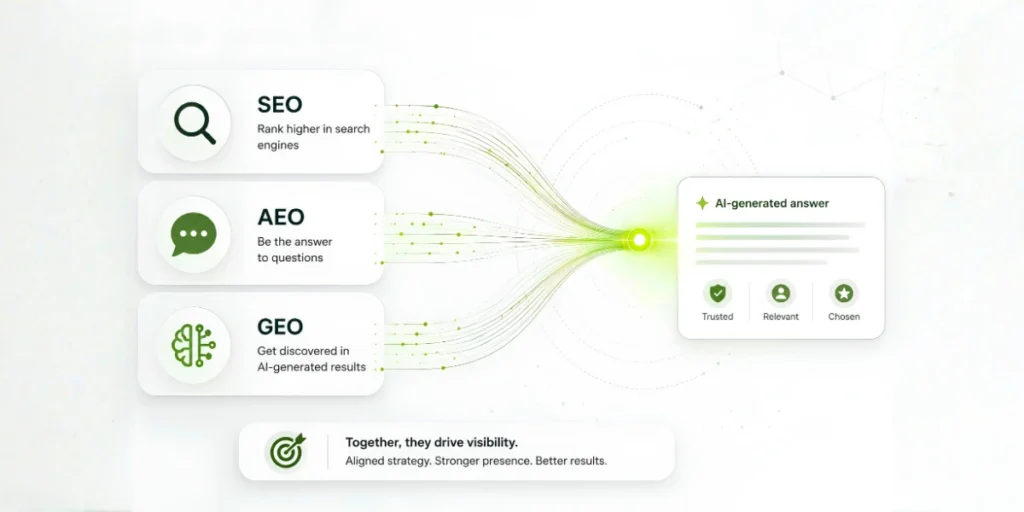
This is the distinction between SEO, AEO, and GEO that most business owners have not yet made. SEO gets you found in traditional search. AEO (Answer Engine Optimization) gets specific passages extracted and cited by AI engines when they answer questions. GEO (Generative Engine Optimization) gets your brand consistently recommended as the answer to relevant queries. All three now run simultaneously in a healthy digital strategy.
The 2026 Action Framework: What Business Owners Must Do Now
Based on ARN Management Consulting’s work across growing businesses and healthcare-adjacent platforms, here is the framework we are applying in 2026.
Step 1: Audit Where AI Engines Currently Cite You
Search your primary service keywords in ChatGPT, Perplexity, and Google. Record whether your brand appears, what sources are being cited instead, and what formats AI is pulling from. This baseline tells you which gaps to close first. Most growing businesses we work with discover they have strong Google rankings and zero AI citations. The gap is strategic, not technical.
Step 2: Restructure Content Around Direct Answers
Every service page and blog post needs a 40-60 word plain-English definition block at the opening of the primary topic section. Every H2 section should open with a 2-3 sentence direct answer before elaborating. FAQ sections with 4-8 questions and 40-100 word answers should appear on every page. These formats are what AI engines extract. Without them, your content exists for human readers but is invisible to AI citation systems.
Step 3: Deploy the Technical Layer
Install Article schema, FAQPage schema, BreadcrumbList schema, and Person schema on every content page. Update your llms.txt file with each new piece of content. These technical signals tell AI crawlers how to index and attribute your content. They do not guarantee citation, but they remove the technical barriers that prevent it.
Step 4: Build Off-Site Entity Presence
Every new piece of content needs distribution beyond your domain. A Reddit post in a relevant community, a LinkedIn article summary, and a Quora answer referencing the piece builds the cross-platform entity signal AI systems use to assess authority. For healthcare operators specifically, this includes ensuring consistent provider information across directories, Google Business Profiles, and review platforms, because AI tools surface inconsistencies that erode recommendation confidence.
Step 5: Measure Citation Share, Not Just Rankings
Traditional rank tracking tells you where you appear on a list of blue links. In 2026, you also need to track citation share: how often your brand or content appears in AI-generated answers for your target queries. This is the new leading indicator of digital authority. Businesses that build citation share now are building the equivalent of first-page rankings for the next decade of search.
Frequently Asked Questions
Will AI replace Google search?
AI search and traditional search are coexisting and converging, not replacing each other. Google itself is integrating AI Overviews into traditional results. What is changing is the mechanism by which visibility converts to traffic. Ranking alone no longer guarantees clicks. Being cited inside AI answers has become an equally important goal.
How does AI search affect my business if I am not in tech?
AI search affects every business that relies on organic digital discovery, including healthcare practices, professional services firms, and local businesses. Research by RLDatix found that 70% of patients are open to using AI tools to research physicians. If your buyers or patients are searching on AI platforms and your business does not appear in those answers, a competitor’s does.
What is the difference between GEO and AEO?
AEO (Answer Engine Optimization) focuses on structuring specific content passages so AI engines extract and cite them when answering questions. GEO (Generative Engine Optimization) focuses on getting your brand consistently recommended as the answer across AI platforms. AEO works at the passage level. GEO works at the brand and entity level. Both run alongside traditional SEO in a complete 2026 strategy.
How do I get cited by ChatGPT or Google AI Overviews?
The core requirements are: structured content with direct-answer passages and FAQ sections, FAQPage and Article schema deployed, consistent entity signals across your domain and off-site platforms, and a named author with demonstrable credentials. These signals tell AI systems that your content is reliable enough to cite. Citation authority is built incrementally through structured, consistent content production.
How should healthcare operators adjust their digital strategy for AI search?
Healthcare operators need to treat AI search as a patient and referral discovery channel. This means ensuring consistent provider information across all directories and review platforms, deploying schema markup on all content pages, publishing FAQ-rich content that answers the questions prospective patients ask AI tools, and building review volume, because AI systems weight patient experience data heavily in healthcare recommendations.
Is it too late to start optimizing for AI search in 2026?
No. Most growing businesses and healthcare operators have not yet adapted, which means the opportunity to establish AI citation authority is still open. Businesses that act in 2026 will have a structural advantage over those that wait for the channel to become more competitive. The analogy is 2014 for SEO: the businesses that optimized early owned positions that compounded for years. The same dynamic is playing out in AI search now.