
How to choose a healthcare marketing agency in Atlanta comes down to four checks: whether the agency has marketed a healthcare product before, whether it understands the clinicians and practice teams who buy from you, whether it plans for AI search as well as Google, and whether it reports on pipeline instead of traffic.
This guide turns those four checks into eight questions you can ask in a first call, the red flags worth walking away from, and what the first 90 days should look like. It is written for founders and marketing leads at health tech and SaaS companies with roughly 10 to 200 people: the stage where founder-led sales stops being enough and a marketing partner starts to make sense.
We wrote it from the agency side of the table. ARN Management is a healthcare marketing agency in Atlanta for health tech companies and medical practices, and these are the questions we would want a buyer to ask us.
Key takeaways
1. Healthcare product experience matters more than general SaaS experience: clinical buyers, long sales cycles and privacy rules change the work.
2. Ask every agency how it plans for AI search. Google says standard SEO best practices still apply to AI Overviews and AI Mode.
3. Judge agencies on pipeline numbers such as demos and qualified leads, not on traffic alone.
4. Ask for a healthcare case study with a named client and real numbers.
5. Walk away from guaranteed rankings, purchased reviews and contracts that leave the agency holding your accounts.
The right agency should be able to explain your buyer back to you better than your own pitch deck does. If they cannot describe who signs the contract, they cannot market to them.

Why do health tech companies need a different kind of marketing agency?
Marketing a health tech product is not the same as marketing a local practice, and it is not the same as marketing a general SaaS tool. Three things change the work.
The buyer. A practice manager, an owner-physician and an IT lead often all have a say, and each cares about something different: staff time, clinical workflow, security. Your content has to speak to all three without losing any of them.
The rules. Health data carries legal weight even outside HIPAA. The Federal Trade Commission’s updated Health Breach Notification Rule, finalized in April 2024, applies to health apps and similar technologies not covered by HIPAA [1]. Before an agency adds tracking pixels or lead forms to your site, it should check how those tools collect and share health data.
How buyers research. More first answers now come from AI. Google’s AI Overviews had more than 2 billion monthly users by mid-2025 [2], and Pew Research Center found that Google users who saw an AI summary clicked a traditional result link in 8% of visits, compared with 15% for users who did not see one [3]. Patients are moving the same way: in rater8’s 2026 survey, 47% of patients had used AI to research healthcare providers [4]. The practices you sell to are already competing for those AI answers, and your company competes for the same kind of answer when a buyer asks which software to use.
What should a healthcare marketing agency do for a health tech company?
At minimum, the agency should cover six areas, as one plan rather than six separate projects:
- Positioning: one clear sentence on who the product is for and what it changes, tested with real buyers.
- Website: use-case, integration and comparison pages that answer what buyers search for, plus a demo path of three clicks or fewer.
- Search: SEO built around buyer-intent keywords, focused on the 5 or 6 terms that bring in buyers rather than 100 that bring in browsers.
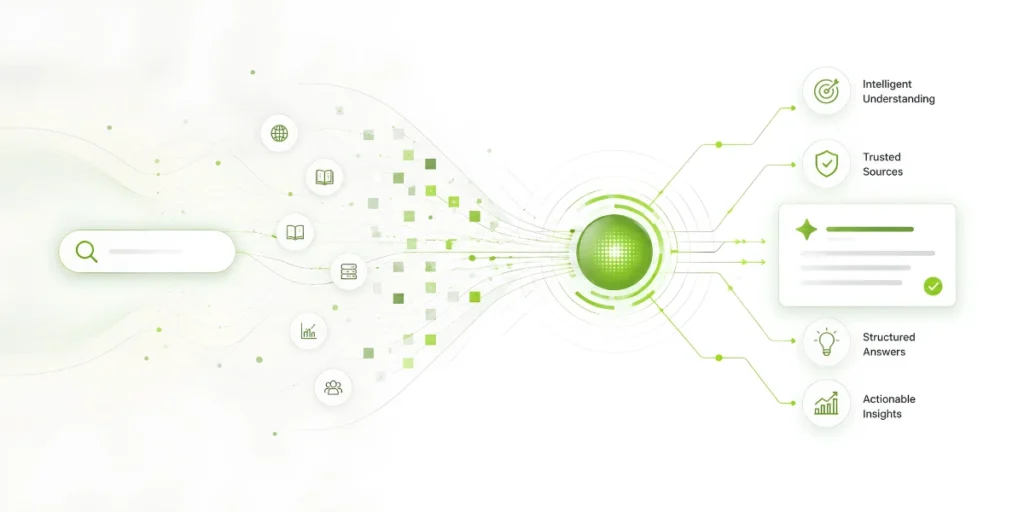
- AI search: content structured so ChatGPT, Perplexity and Google AI Overviews can quote it. This is the work usually called answer engine optimization.
- LinkedIn: a regular founder voice, with company page posts that support it.
- Proof: case studies with real numbers that your sales team can send after a demo.
If an agency only offers one of these, you will end up managing several vendors to cover the rest.
What questions should you ask before you hire a healthcare marketing agency?
The fastest way to learn how to choose a healthcare marketing agency is to ask the same eight questions of every agency you speak to. Strong agencies answer most of them with specifics. Weak ones answer with adjectives.
1. Have you marketed a healthcare product, or only healthcare practices?
Many healthcare agencies focus on practices: patient reviews, Google Maps, local ads. That work matters, but it is a different job from selling software to those practices. Ask for an example of a health tech or SaaS client and what changed for them.
2. Who do you think buys our product?
A good agency asks about your buyer before it pitches. Listen for whether they separate the person who uses your product from the person who signs for it, and whether they understand how a practice or health system makes that decision.
3. How do you handle health privacy rules in marketing?
Ask how they set up analytics, tracking pixels and lead forms on a health tech site, and how those tools handle health data. The FTC’s April 2024 rule update covers health apps outside HIPAA [1], and its August 2024 rule bans fake reviews and testimonials, including AI-generated ones, with civil penalties for knowing violators [5]. A strong agency brings up these rules before you ask.
4. What is your plan for AI search?
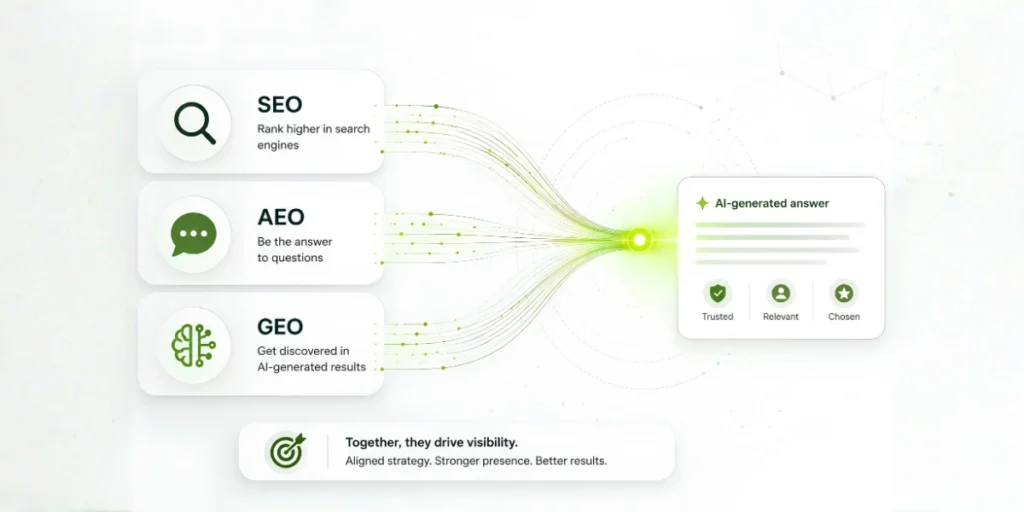
Ask how they will get your company named in ChatGPT, Perplexity and Google AI Overviews. Be wary of anyone selling a secret method: Google’s documentation says there are no additional requirements to appear in AI Overviews or AI Mode, and that SEO best practices remain relevant [6]. The real work is clear pages, direct answers, consistent descriptions of your product across the web, and content that earns citations. Our explainer on the difference between GEO, AEO and SEO covers the terms, and our AEO services page shows how we approach it.
5. How will you report results?
Traffic alone is a weak measure, especially now that fewer searches end in a click [3]. Ask to see a sample report. It should connect the work to demos booked, qualified leads and the pages that produced them, with rankings and AI citations as supporting numbers.
6. Can you show a healthcare case study with real numbers?
Ask for a named client, the starting point, what the agency did and what changed. Our own example is ClinicianCore, a clinical communication platform for physician practices. In a 3-month Google Search Console comparison, impressions grew from 7.78K to 39.7K (+410%), clicks grew from 60 to 150 and average position improved from 30 to 14.1. The site also reached #1 on 4 pillar keywords and earned 4 Google AI Overview citations [7]. The full ClinicianCore case study shows the method. Whatever an agency shows you, check that it is real: the FTC’s 2024 rule makes fake testimonials an enforcement target [5].
7. Who will actually do the work?
Find out who writes, who builds and who reports, and whether those people have healthcare experience. Google’s guidance on helpful content asks publishers to make clear who created content, how and why, and holds topics that affect health to a higher standard of accuracy [8]. Content written by someone who has never spoken to a clinician tends to read that way.
8. What does the contract look like?
Ask about term length, notice period and who owns the website, content, ad accounts and analytics if you part ways. You should own all of them. A short term with a clear 90-day plan is a better sign than a long lock-in.
What are the red flags when hiring a healthcare marketing agency?
- Guaranteed rankings or guaranteed AI citations. No agency controls Google or ChatGPT.
- Reports that show traffic and impressions but never demos or leads.
- No healthcare clients, or only practice clients when you sell software.
- Offers to buy reviews or write testimonials for you. Under the FTC’s 2024 rule, that can bring civil penalties [5].
- The agency, not you, owns your domain, website or ad accounts.
- A long contract with no written plan for the first 90 days.
Should a health tech company hire an agency, build in-house or use freelancers?
Part of knowing how to choose a healthcare marketing agency is deciding whether you need one at all. Here is how the three options compare for a company with 10 to 200 people.
| Option | Works best when | Watch out for |
|---|---|---|
| Agency | You need strategy, content, SEO and AI search covered at once, without hiring three or four people | Agencies with practice experience but no healthcare product experience |
| In-house team | You have steady demand and budget for a marketing lead plus specialists | Slow to hire, and one person rarely covers SEO, AI search, content and design |
| Freelancers | You need one defined task done, such as a website rebuild | You become the project manager and the strategist |
Many growing health tech companies end up with one internal owner of marketing working alongside one agency that handles the specialist work.
What should the first 90 days with a healthcare marketing agency look like?
- Days 1 to 30, audit and baseline: record your rankings and what ChatGPT, Perplexity and Google AI Overviews say about you today. Agree on 5 or 6 keywords and the page that should rank for each.
- Days 31 to 60, fix and publish: update the homepage and key product pages, publish the first buyer-focused content and set up reporting tied to demos.
- Days 61 to 90, reach out and measure: start a founder-led LinkedIn rhythm, use the new content in sales follow-ups and review what moved.
By day 90 you should know which pages and messages bring in qualified conversations. Rankings and AI visibility keep building after that; our guide to generative engine optimization explains why the timeline runs in months, not weeks.
Why does an Atlanta agency matter for Atlanta health tech companies?
Search engines and AI tools do not care where your agency sits. Relationships do. An agency in Atlanta can meet your team in person, knows the local health tech community and its events, and can bring your company into conversations with the practices and partners nearby. That matters most when your first customers are regional.
If you are comparing options, ARN is a healthcare marketing agency in Atlanta for health tech companies and medical practices. You can see how we work on our healthcare marketing agency Atlanta page.
Frequently asked questions
What does a healthcare marketing agency do for a health tech company?
A healthcare marketing agency helps a health tech company reach the clinicians and practice teams who buy its product, through positioning, website pages, SEO, AI search and LinkedIn. With Google AI Overviews used by more than 2 billion people a month (Google, 2025), ARN plans for AI answers as well as rankings.
How do I choose a healthcare marketing agency in Atlanta?
Start with four checks: healthcare product experience, an understanding of your buyer, a plan for AI search and reporting tied to pipeline. Then ask for a named case study, because the FTC now bans fake reviews and testimonials with civil penalties for knowing violators (FTC, 2024). ARN shares its ClinicianCore results openly.
Why does AI search matter when choosing a marketing agency?
AI search changes whether buyers click through to your site at all. Google users who saw an AI summary clicked a traditional result in 8% of visits, compared with 15% without one (Pew Research Center, 2025). Your agency should plan for being quoted in AI answers, which ARN builds into its search work.
Are patients really using AI to find healthcare providers?
Yes, and the share is growing. In rater8’s 2026 survey, 47% of patients had used AI tools to research healthcare providers, and AI tools influenced 36% of new-doctor choices, ahead of Google search results at 34% (rater8, 2026). ARN treats AI visibility as a core channel for clients that sell to practices.
What results should I expect from a healthcare marketing agency in 90 days?
Within 90 days, expect a clear baseline, fixed key pages, early content and reporting tied to demos, with rankings building over the following months. As one benchmark, ARN’s ClinicianCore work grew impressions from 7.78K to 39.7K in a 3-month Search Console comparison (ARN, 2026). No agency should guarantee rankings
References
[1] The updated Health Breach Notification Rule applies to health apps and similar technologies not covered by HIPAA. Source: Federal Trade Commission, FTC Finalizes Changes to the Health Breach Notification Rule, 2024
[2] AI Overviews has over 2 billion monthly users across more than 200 countries and territories. Source: Google, Alphabet Q2 earnings call: CEO’s remarks, 2025
[3] Users who saw an AI summary clicked a traditional search result in 8% of visits, compared with 15% for users who did not see one. Source: Pew Research Center, Google users are less likely to click on links when an AI summary appears in the results, 2025
[4] 47% of patients have used AI to research healthcare providers; AI tools were cited by 36% of searchers, ahead of Google search results at 34%. Source: rater8, 2026 Patient Choice Report, 2026
[5] The final rule bans fake reviews and testimonials, including AI-generated ones, and lets the FTC seek civil penalties against knowing violators. Source: Federal Trade Commission, Federal Trade Commission Announces Final Rule Banning Fake Reviews and Testimonials, 2024
[6] There are no additional requirements to appear in AI Overviews or AI Mode; SEO best practices remain relevant. Source: Google Search Central, AI features and your website, 2025
[7] ClinicianCore: impressions 7.78K to 39.7K (+410%), clicks 60 to 150, average position 30 to 14.1 (3-month comparison); #1 on 4 pillar keywords; 4 Google AI Overview citations. Source: ARN Management, ClinicianCore SEO, GEO & AEO Case Study, 2026
[8] Google asks publishers to make clear who created content, how and why; content on topics that affect health or well-being must be highly accurate. Source: Google Search Central, Creating helpful, reliable, people-first content, 2026